Solution guide · SMS & compliance
A2P 10DLC news: what changed in November 2026 and what to do about it
A2P 10DLC news for November 2026: Twilio’s new rejection codes, HighLevel’s new SMS pause rules, the FCC opt-out change and carrier fees — with fixes.

Key takeaways
- As of November 2026 there are four A2P 10DLC changes to act on: Twilio’s new campaign rejection codes from 9 December 2026, HighLevel’s new SMS restriction thresholds, the FCC consent-revocation rule from 25 November 2026, and per-text carrier fees.
- Twilio’s new codes name the exact problem, such as a campaign description that does not name the registered business (30977), leftover template text (30984) or a Privacy Policy page that did not load (30973), so fix exactly what the code names before you resubmit.
- HighLevel now warns at a 4% opt-out rate or 15% carrier filtering and pauses at 6% or 25%, measured over the last 7 days, and standard pauses last 12 hours instead of 24–48. It is being rolled out in phases.
- From 25 November 2026, informational texts can treat an opt-out as covering only that category, and you can name one exclusive opt-out method; an opt-out from marketing still stops all marketing.
- Resubmitting a rejected campaign in HighLevel has been free since 1 February 2026, so fix the cause properly rather than starting a new campaign.
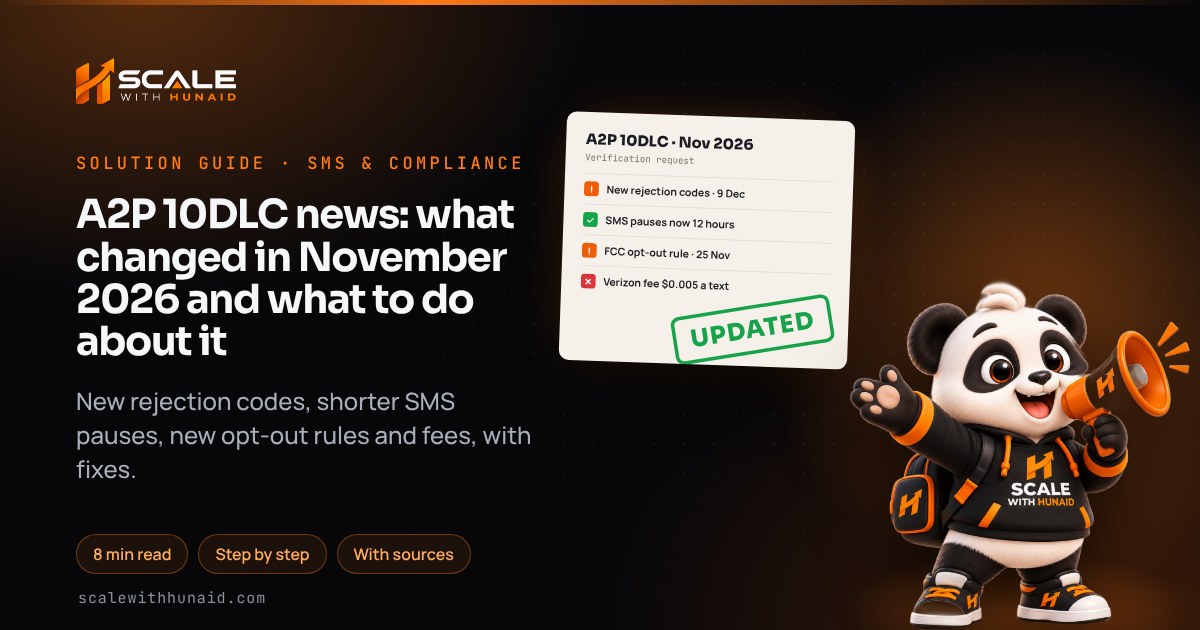
A2P 10DLC news, as of November 2026: four changes affect anyone texting from a US local number. Twilio adds more specific campaign rejection codes from 9 December 2026. HighLevel has made SMS restrictions shorter but stricter about opt-out rates. The FCC’s new opt-out rules start on 25 November 2026. Carrier fees are now up to $0.005 a text. Below is what to do about each one.
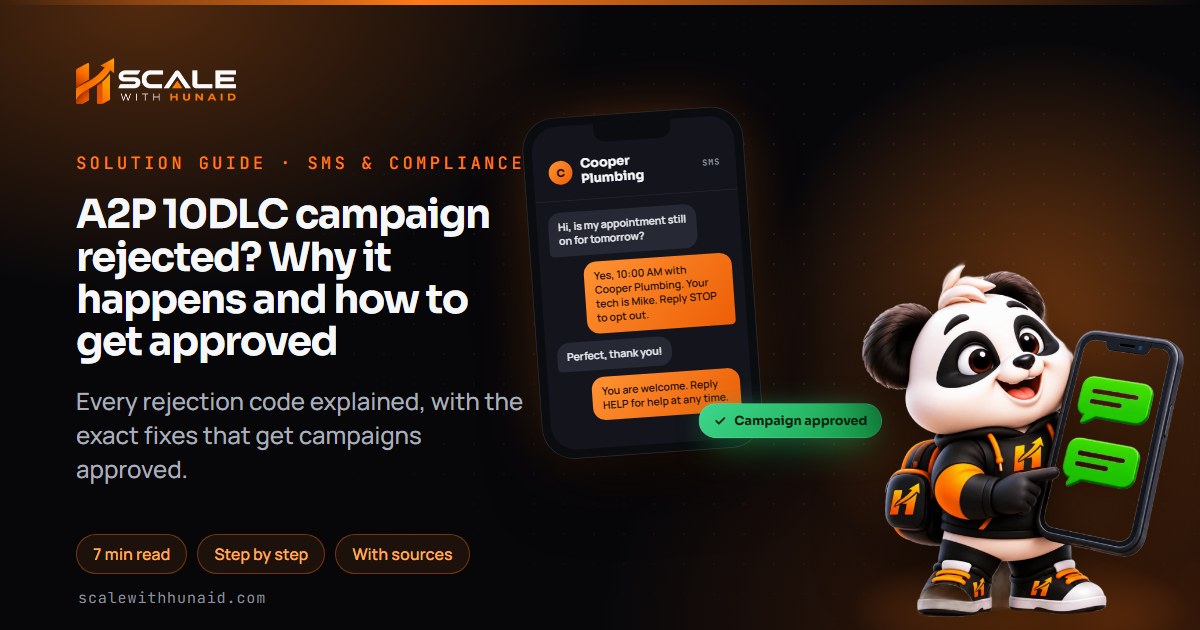
I keep this page for my A2P 10DLC registration clients, so each change comes with the exact fix and a link to the official source. If your campaign has already been rejected, my full A2P 10DLC campaign rejected guide covers every older code too.
A2P 10DLC news at a glance (November 2026)
| Date | What changed | Who it affects | Official source |
|---|---|---|---|
| 9 Dec 2026 | More specific campaign rejection codes (description, message flow, privacy policy and terms) | Anyone submitting or resubmitting a campaign | Twilio changelog |
| 10 Nov 2026 | New SMS restriction thresholds, 12-hour pauses, self-service resume (phased rollout) | HighLevel / LC Phone sub-accounts | HighLevel changelog |
| 25 Nov 2026 | Amended TCPA consent-revocation rules take effect | Every business sending informational or marketing texts | Federal Register |
| 15 Sep 2026 | Shared, more specific codes for 10DLC and toll-free rejections | Rejections since mid-September | Twilio changelog |
| 1 Feb 2026 | Campaign resubmissions free in HighLevel | HighLevel users fixing rejections | HighLevel billing guide |
Nothing on this list means an approved campaign has to be registered again. These changes affect how rejections are reported, when sending gets paused, how opt-outs work and what each text costs.
- 9 Decnew Twilio campaign rejection codes start(Twilio changelog)
- 12hours for a standard HighLevel SMS pause, down from 24–48(HighLevel changelog)
- 25 NovFCC opt-out rule changes take effect(Federal Register)
- $0.005Verizon carrier fee per outbound SMS(Twilio pricing)
Twilio’s new A2P 10DLC rejection codes from 9 December 2026
Twilio’s changelog says US A2P 10DLC campaign rejections will carry more specific error codes from 9 December 2026, grouped into three areas: the campaign description, the message flow (how people opt in) and the Privacy Policy and Terms pages. HighLevel shows Twilio’s codes in the Trust Center, and its rejection reasons article already moved to granular codes on 23 March 2026, so expect the new numbers there too.
These are the codes Twilio has published so far, with the fix I apply:
| Code | What Twilio says | The fix |
|---|---|---|
| 30977 | Campaign description doesn’t name the business you registered | Start the description with the exact brand name, e.g. “Cooper Plumbing LLC sends…” |
| 30984 | Description has unfilled template text | Delete every placeholder such as [Business Name] or {{company}} |
| 30986 | Campaign type doesn’t match the texts in the description | Pick the use case that matches what you actually send, or rewrite the samples |
| 30965 | Sign-up proof doesn’t open or can’t be read | Upload a clear screenshot or a public URL that opens without a login |
| 30973 | Privacy Policy page didn’t load | Publish the page on your live domain and test it in a private window |
The same entry adds codes for missing text-to-join instructions, a website form with no phone number field, Privacy Policy or Terms pages with too little text, and two links that point to different documents.
How to fix a rejection with one of the new codes
- Open the rejection. In HighLevel go to Settings → Phone System → Trust Center → A2P Messaging (SMS) → Brand & Campaigns, then use View required fixes on the Campaigns tab, per HighLevel’s rejection reasons article (as of November 2026). Note every code listed, not just the first.
- Fix the description. Write two or three plain sentences: “Cooper Plumbing LLC sends appointment reminders and service updates to customers who opt in on cooperplumbing.com/book. Message frequency varies.” No placeholders, and it must name the brand.
- Fix the proof of opt-in. Link a live page that shows the form, including the phone field and an unticked consent box, or upload a readable screenshot of it.
- Fix the policy pages. Make sure the Privacy Policy and Terms links each open a different, complete page with real text, including a line that SMS opt-in data is never shared with third parties for marketing.
- Check the use case. Your sample messages must match the campaign type. Marketing samples on a customer-care campaign get rejected.
- Resubmit once. HighLevel says you can resubmit eligible rejections from the portal once all listed reasons are addressed, and that forbidden or high-risk content should not be resubmitted at all.
HighLevel’s new SMS restriction rules (10 November 2026)
The biggest HighLevel change this month is how LC Phone decides to pause bulk SMS. In its changelog post “Fewer SMS Restrictions, More Confidence in Messaging”, HighLevel says it rebuilt its compliance safeguards and that initial testing showed 80% fewer messaging restrictions. The new thresholds, as of November 2026:
| Signal (last 7 days) | Early warning | Temporary pause |
|---|---|---|
| Opt-out rate | 4% | 6% |
| Carrier-reported filtering (error 30007 only) | 15% | 25% |
| Standard pause length | — | 12 hours (was 24–48) |
Three more details matter. Eligible agency owners can now resume messaging themselves. 1:1 messages in Conversations stay available during bulk restrictions. The safeguards for newly created sub-accounts are unchanged. The rollout is phased, so some sub-accounts still run on the older daily ramp-up limits in the LC Phone Messaging Policy. Those limits go from 500 to 5,000+ SMS a day, with a 24-hour pause if you hit the cap.
How to stay under the new thresholds
- Watch opt-outs per send, not per month. A 6% opt-out rate over 7 days is easy to hit with one bulk blast to an old list. Send to contacts who engaged in the last 90 days first.
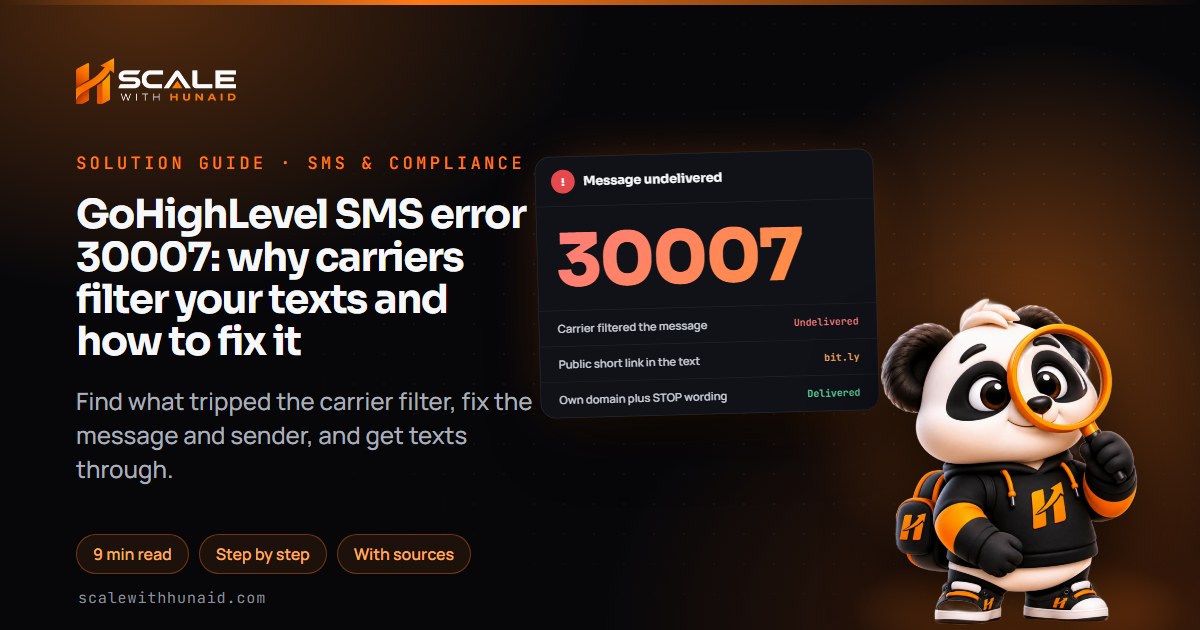
- Clean out 30007 filtering. Only 30007 counts towards the filtering rate, so remove URL shorteners, ALL-CAPS offers and missing business names. My SMS error 30007 guide has the full content fix.
- Name the sender and the opt-out. Check Settings → Phone Numbers → Advanced Settings → SMS Compliance so the first message carries your business name and “Reply STOP to unsubscribe”, per HighLevel’s compliance settings article (as of November 2026).
- Drip, don’t blast. In bulk actions and workflows, send in batches so a bad segment shows up in warnings before it triggers a pause.
- If you are paused, read the notice (HighLevel says it now explains the cause and duration), fix that cause, keep replying 1:1 from Conversations, and resume when the notice shows you are eligible.
The FCC opt-out rule change on 25 November 2026
The FCC’s amended consent-revocation rules were published in the Federal Register on 26 October 2026, and an FCC public notice confirms they take effect on 25 November 2026. They replace the delayed “revoke all” date that had been pushed to 31 January 2027.
What changes for texting:
- An opt-out sent in reply to one category of informational message (for example, appointment reminders) can be treated as covering only that category.
- You may name one exclusive opt-out method, such as a standard reply keyword, an automated opt-out or a set web page or phone number.
- An opt-out from marketing or telemarketing still stops all future marketing from you.
What to set up in GoHighLevel before 25 November
- Split your consent. Use separate checkboxes for reminders and marketing on every form, and tag contacts by category so an opt-out can be applied to the right one.
- State the opt-out method in the first message (“Reply STOP to opt out”) and in your SMS terms.
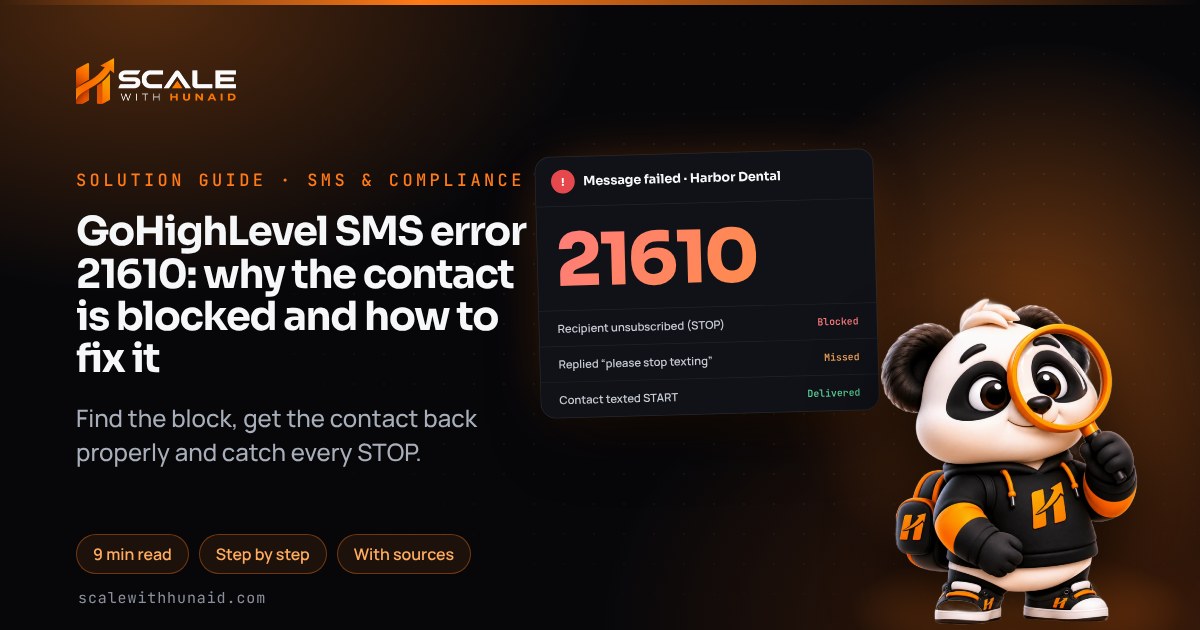
- Catch plain-English opt-outs. Carrier keyword matching only catches single words like STOP. My SMS error 21610 guide shows the workflow that catches “please stop texting me”.
- When unsure, stop everything. If you cannot tell which category someone opted out of, set DND for SMS on the whole contact.
A2P 10DLC carrier fees per text (as of November 2026)
Every outbound text on a registered 10DLC number carries a carrier surcharge on top of the platform price. Twilio’s US SMS pricing page lists these per-segment fees for long codes:
Fees are charged per segment, so a two-segment text costs double. Twilio says prices may change without notice.
Source: Twilio, SMS Pricing in the United States (November 2026)
HighLevel’s billing guide says LC Phone carrier fees are passed through at Twilio’s rates, and that resubmissions have been free since 1 February 2026. Its fees article lists the one-time registration bundle at $22.50 (Sole Proprietor and Low Volume Standard) or $64 (High Volume Standard), plus $15 for each additional campaign.
To keep the fee down: keep texts under 160 GSM characters (one segment), avoid emoji, which switch a text to a 70-character limit, and don’t send MMS where a link will do.
State rules that sit on top of A2P 10DLC
A2P 10DLC approval covers the carriers, not state law. Texas extended its mini-TCPA (SB 140) to texts from 1 September 2025, and HighLevel added a Texas SMS Safeguard that blocks marketing texts to Texas numbers. Turn it on per sub-account under Settings → Phone System → Messaging → Texas SMS Safeguard → Save (as of November 2026). 1:1 and transactional messages still send. If you text customers there, see my Texas page; for Florida’s quiet hours and frequency limits, see the Florida page.
Gets rejected or paused
- Avoid: Description with [Business Name]
- Avoid: Privacy link that 404s
- Avoid: One consent box for everything
- Avoid: Blasting a stale list
- Avoid: Shortened links in texts
Approved and sending
- Do: Description names the brand
- Do: Live Privacy and Terms pages
- Do: Separate reminder and promo consent
- Do: 90-day engaged contacts first
- Do: Full links on your own domain
My checklist for this month
- Open every pending or rejected campaign in the Trust Center and fix each code before 9 December.
- Test your Privacy Policy, Terms and opt-in page links in a private browser window.
- Check your 7-day opt-out rate and 30007 rate before your next bulk send.
- Split consent by category and confirm the opt-out wording before 25 November.
- Turn on the Texas SMS Safeguard if you send marketing texts and are not registered there.
Approval times have not changed: Twilio’s vetting FAQ still says up to 5 business days for a standard review, so leave time before any campaign launch.
Get your A2P 10DLC set up for what comes next
These changes reward the same habits: a campaign that names the business clearly, live policy pages, clean consent and lists people actually want to hear from. If you would rather not track every Twilio and HighLevel update yourself, I handle A2P 10DLC registration and ongoing email and SMS deliverability for GoHighLevel accounts. If your brand rather than your campaign was rejected, start with the A2P brand registration rejected guide.

References
- New error codes for A2P 10DLC campaign rejections — Twilio Changelog
- New error codes provide clearer TFV and A2P 10DLC registration feedback launching September 15, 2026 — Twilio Changelog
- A2P 10DLC Campaign Registration Rejected — Twilio Help Center
- Fewer SMS Restrictions, More Confidence in Messaging — HighLevel Changelog
- Understanding A2P Campaign Rejection Reasons & Required Fixes — HighLevel Support Portal
- LC Phone Messaging Policy — HighLevel Support Portal
- LC Phone Pricing & Billing Guide — HighLevel Support Portal
- A2P 10DLC Messaging Fees: Registration, Monthly & Carrier Costs — HighLevel Support Portal
- Configuring Sender ID and Opt-Out Language for SMS Compliance — HighLevel Support Portal
- Texas SMS Safeguard: one-toggle block for SB 140 — HighLevel Support Portal
- Enhancing the Ability of Consumers To Control Robocalls (final rule) — Federal Register
- Public Notice DA 26-1159: effective date of the amended consent revocation rules — Federal Communications Commission
- SMS Pricing in the United States — Twilio
- A2P 10DLC Campaign Vetting FAQ — Twilio Help Center